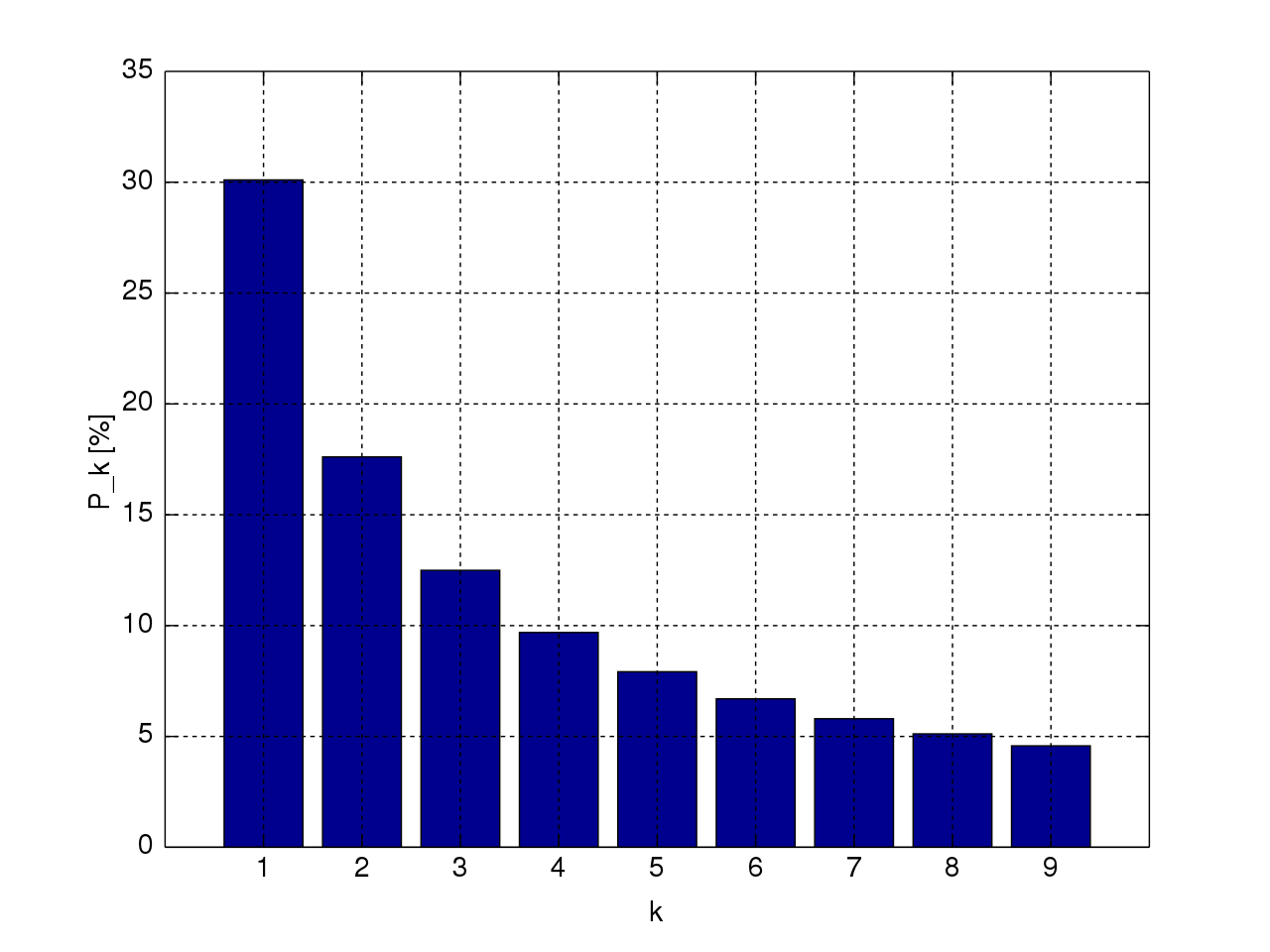
The leading digit '1' appears about 30% of the time in datasets following Benford's law
Benford's law
The leading digit '1' appears about 30% of the time in datasets following Benford's law
Benford's law predicts the frequency of leading digits in many real-life numerical datasets. The law states that the number 1 appears as the leading significant digit about 30% of the time, while 9 appears less than 5% of the time. This observation is based on the assumption that the dataset values are uniformly distributed on a logarithmic scale.
Example
In a dataset of financial transactions, if we apply Benford's law, we would expect to see the digit '1' as the leading digit in approximately 30% of the transactions, while '9' would appear as the leading digit in less than 5% of the transactions.
Understanding Benford's law helps in identifying anomalies and potential fraud in datasets, as real-world data often follow this pattern.
Related concepts
Monty Hall problem
Switching wins 2/3 of the time
Pi
Pi has been calculated to over 100 trillion digits
Googol
A googol is 10^100 — Google was named after it (misspelled)
Henrietta Swan Leavitt
Henrietta Leavitt discovered the period-luminosity relation of Cepheid variables
There are more possible chess games than atoms in the observable universe
"There are more possible chess games (10^120) than atoms in the observable universe (10^80)."
Perfect number
A perfect number equals the sum of its proper divisors
One email a day: 5 concepts + the 5 stories that matter →
Swipe through 100 ML concepts daily
Open TickerNews