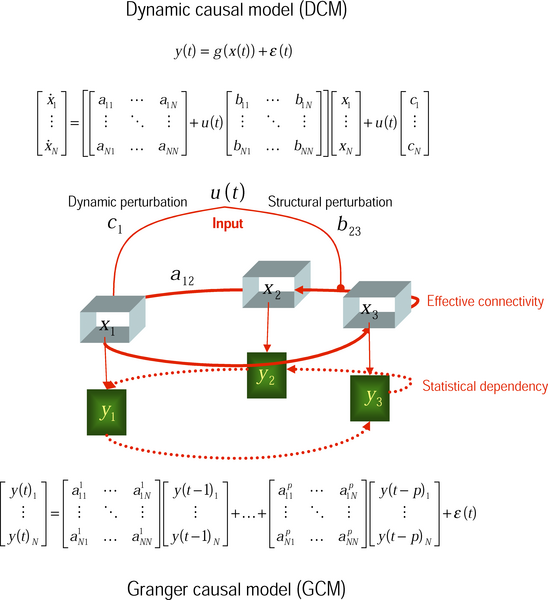
Causal models use DAGs to represent causal relationships
Causal model
Causal models use DAGs to represent causal relationships
Causal models, including DAGs, are conceptual tools that depict the causal mechanisms within a system. They utilize formal causal notation, such as structural equation modeling or DAGs, to illustrate the relationships among variables and guide causal inference.
Example
In studying the effects of environmental exposures on health, researchers can use DAGs to map out the causal relationships between variables like pollution levels, respiratory conditions, and demographic factors.
Understanding causal relationships through DAGs is crucial for designing effective empirical studies and interpreting results accurately.
Related concepts
the back-door criterion identifies: sufficient adjustment sets for causal estimation
The back-door criterion identifies sufficient adjustment sets for causal estimation
Manifold hypothesis
High-dimensional data lies on lower-dimensional manifolds
an instrumental variable does: isolates causal effect when you can't randomize
Instrumental variables isolate causal effects in non-randomized studies
the do-calculus does: computes interventional probabilities from observational data
Do-calculus computes interventional probabilities from observational data
Graph neural network
Graph pooling reduces graphs to single vectors for graph-level prediction
Masking (behavior)
Causal masking prevents attention to future tokens in the decoder
One email a day: 5 concepts + the 5 stories that matter →
Swipe through 100 ML concepts daily
Open TickerNews