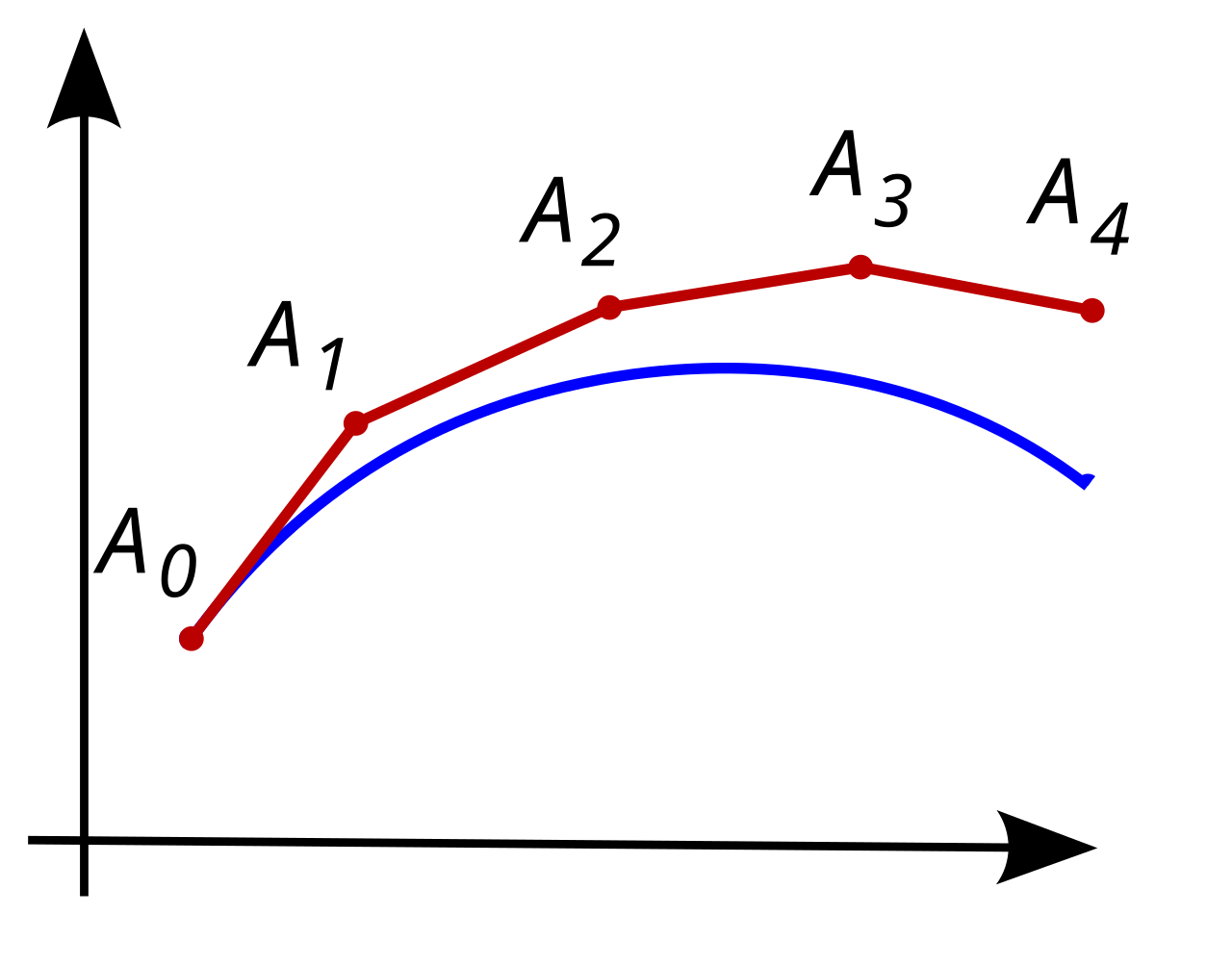
Euler method approximates ODE solution with y_{n+1} = y_n + h·f(y_n)
Euler method
Euler method approximates ODE solution with y_{n+1} = y_n + h·f(y_n)
The Euler method is a numerical procedure for solving ordinary differential equations (ODEs) with a given initial value. It is the most basic explicit method for numerical integration of ODEs and is the simplest Runge–Kutta method. Named after Leonhard Euler, who first proposed it in his book Institutionum calculi integralis (published 1768–1770).
The Euler method is a first-order method, which means that the local error (error per step) is proportional to the square of the step size, and the global error (error at a given time) is proportional to the step size. This indicates that the accuracy of the solution depends on the step size chosen for the approximation.
The Euler method often serves as the basis to construct more complex methods, such as the predictor–corrector method. This shows its foundational role in numerical analysis and its importance in developing more advanced techniques for solving ODEs.
Example
Consider the ODE dy/dx = x + y with an initial condition y(0) = 1. Using the Euler method with a step size h = 0.1, we can approximate the solution at x = 0.1 as follows: y_{1} = y_{0} + h·f(y_{0}) = 1 + 0.1·(0 + 1) = 1.1
Understanding the Euler method is crucial for solving ODEs numerically and serves as a foundation for more complex numerical methods.
Related concepts
Monte Carlo method
Delta method approximates variance of g(X) ≈ [g'(μ)]² Var(X)
Finite element method
Runge-Kutta method improves Euler by providing higher-order accuracy with k₁,k₂,k₃,k₄
iterative methods (CG, GMRES) do: solve Ax=b without explicitly inverting A
CG, GMRES iteratively solve Ax=b without explicitly inverting A
approximation algorithms guarantee: solution within factor α of optimal
Approximation algorithms guarantee a solution within a factor α of the optimal solution
Physics-informed neural networks
Neural ODEs model continuous-time dynamics with a neural network as the derivative
Euler's identity
Euler's identity: e^(iπ) + 1 = 0
One email a day: 5 concepts + the 5 stories that matter →
Swipe through 100 ML concepts daily
Open TickerNews