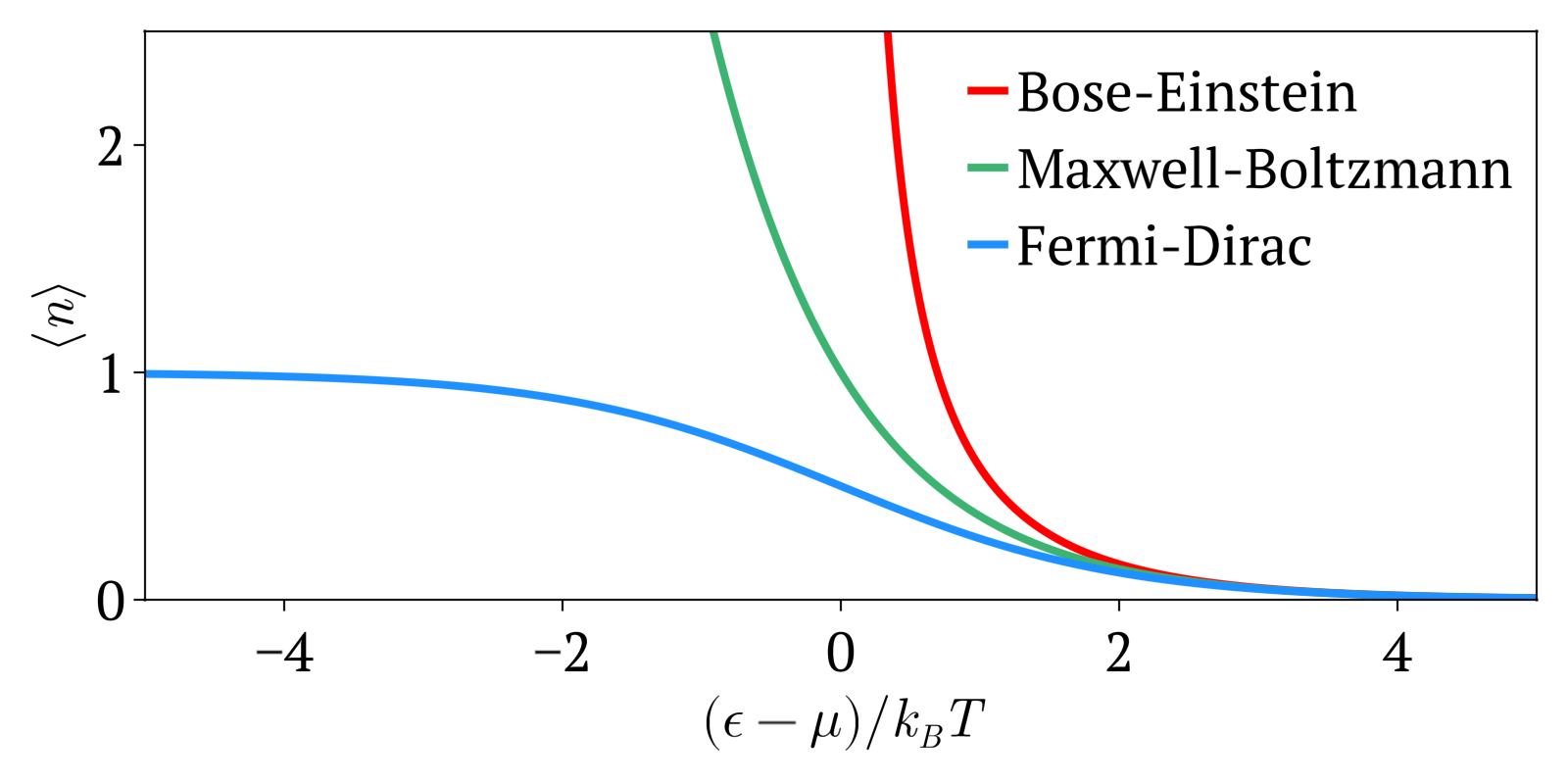
Fermi-Dirac statistics govern fermions' energy distribution
Fermi–Dirac statistics
Fermi-Dirac statistics govern fermions' energy distribution
Fermi-Dirac statistics describe the distribution of fermions over energy states, ensuring no two particles occupy the same state due to the Pauli exclusion principle.
Fermi-Dirac statistics apply to identical particles with half-integer spin, such as electrons, influencing their thermodynamic behavior.
The Fermi-Dirac distribution was independently derived by Enrico Fermi and Paul Dirac in 1926, highlighting its significance in quantum mechanics and statistical mechanics.
Example
Electrons in a metal at absolute zero fill up energy states up to the Fermi energy, leaving no vacancies above it.
Understanding Fermi-Dirac statistics is crucial for explaining the behavior of fermions in various physical systems.
Related concepts
Spin–statistics theorem
Spin-statistics theorem links particle spin to statistics
Maxwell–Boltzmann distribution
Probability of a state with energy E is proportional to e^(-E/kT)
the Pauli exclusion principle forbids
Pauli exclusion principle forbids two identical fermions from occupying the same quantum state
Dirac equation
Dirac equation implies existence of antimatter
Solitary confinement
Free quarks are never observed; they're always bound in hadrons
Supersymmetry
Every fermion has a bosonic partner and vice versa
One email a day: 5 concepts + the 5 stories that matter →
Swipe through 100 ML concepts daily
Open TickerNews