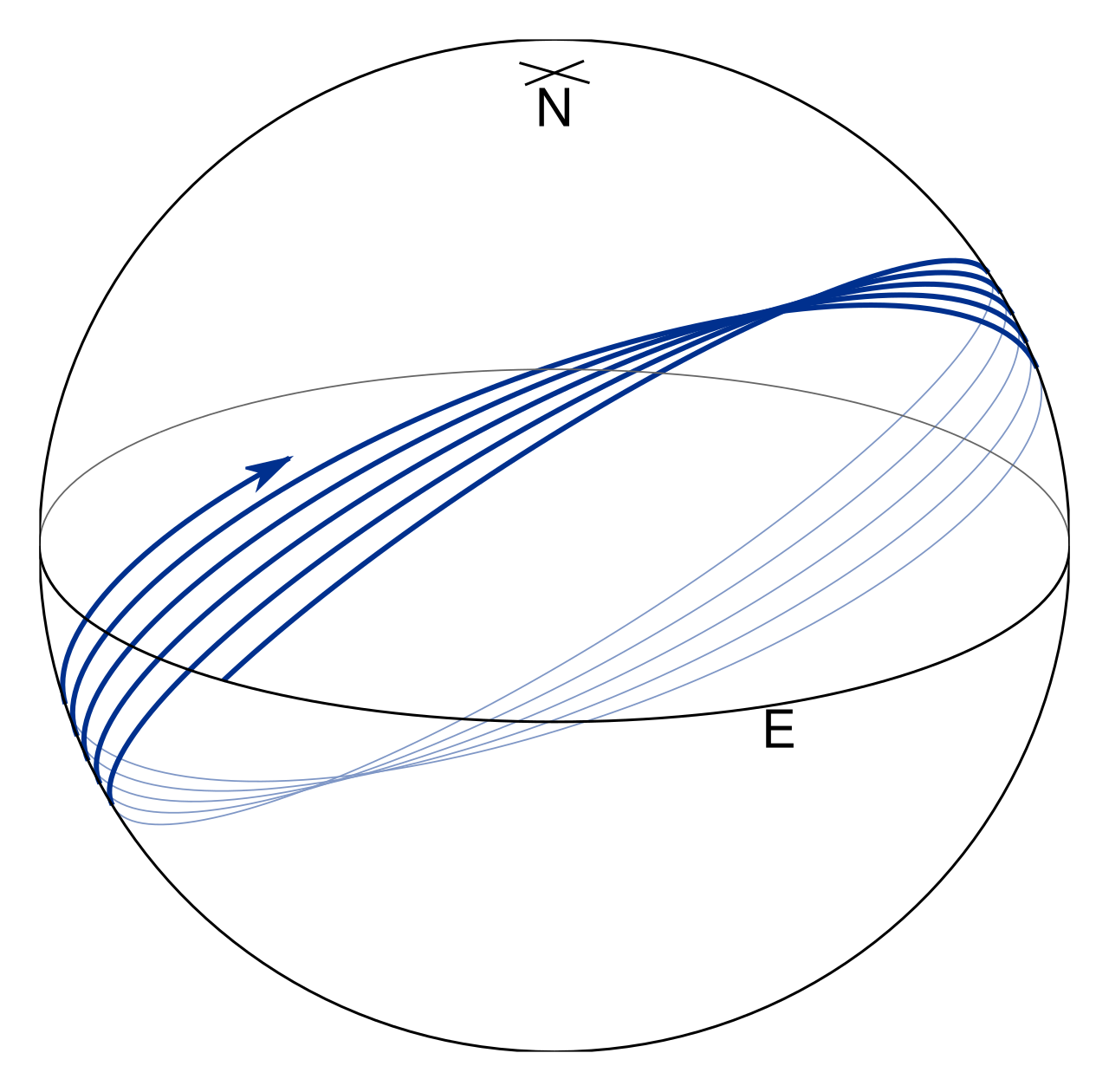
Geodesics are the shortest paths on a curved surface
Geodesics on an ellipsoid
Geodesics are the shortest paths on a curved surface
Geodesics are analogous to straight lines on a plane surface. They represent the shortest distance between two points on a curved surface, such as an ellipsoid or sphere. This concept is crucial in fields like geodesy and navigation.
Example
On an ellipsoid, the shortest path between two points is not necessarily a straight line, but a geodesic that curves along the surface.
Understanding geodesics is essential for accurate mapping and navigation on curved surfaces like Earth.
Related concepts
Riemannian manifold
Riemannian manifolds generalize Euclidean space concepts like distance and curvature
Curvature
Curvature measures the angular rate of change of the direction of the tangent line per unit distance along the curve
saddle points are more common than local minima in high dimensions
Saddle points arise due to mixed partial derivatives being zero, leading to more complex curvature in high dimensions
non-convex loss landscapes are hard: many local minima and saddle points
Non-convex loss landscapes are hard due to many local minima and saddle points
BFS vs DFS: BFS finds shortest path in unweighted graphs, DFS uses less memory
BFS finds shortest path in unweighted graphs; DFS uses less memory
Chebyshev distance
Chebyshev distance is named after Pafnuty Chebyshev
One email a day: 5 concepts + the 5 stories that matter →
Swipe through 100 ML concepts daily
Open TickerNews