Logistic regression probability formula: P(Y=1) = 1 / (1 + exp(-z))
Logistic regression
Logistic regression probability formula: P(Y=1) = 1 / (1 + exp(-z))
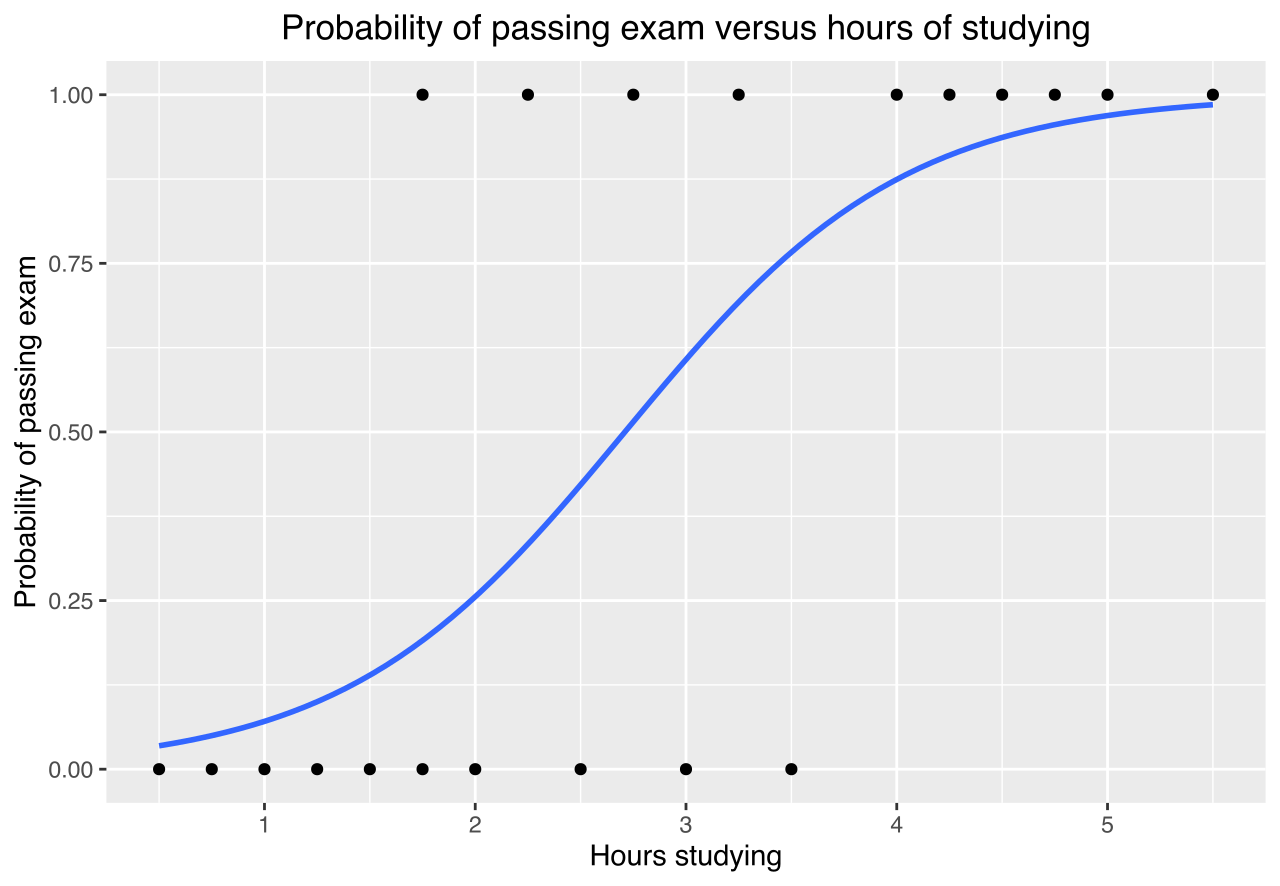
Logistic regression is a statistical model used to predict the probability of a binary outcome. The formula P(Y=1) = 1 / (1 + exp(-z)) represents the probability of the event occurring, where z is the linear combination of independent variables and their coefficients.
The logistic function, exp(-z), transforms the linear combination z into a value between 0 and 1, which can be interpreted as the log-odds of the event. This transformation is crucial for converting the linear combination into a probability.
Understanding this formula is essential for interpreting logistic regression results and making predictions about binary outcomes based on input variables.
Example
Suppose we have a logistic regression model predicting whether a patient has a disease (Y=1) based on age (X1) and blood pressure (X2). The model's equation might be: z = -2 + 0.03*X1 + 0.05*X2. For a patient aged 50 with a blood pressure of 120, the calculation would be: z = -2 + 0.03*50 + 0.05*120 = 3.5. The probability of the patient having the disease is P(Y=1) = 1 / (1 + exp(-3.5)) ≈ 0.97.
Knowing the logistic regression probability formula allows researchers and analysts to make informed predictions about binary outcomes, which is crucial in fields like medicine, marketing, and social sciences.
Related concepts
Expected value
Expected value formula: E[X] = Σ [x * P(x)]
Conditional probability
P(A|B) = P(A ∩ B) / P(B)
Poisson distribution
Poisson distribution formula: P(k; λ) = (λ^k * e^(-λ)) / k!
Entropy (information theory)
H(X) = −∑x∈X p(x) log(p(x))
BLEU
BLEU = exp(Σ(w_t * log(p_t)))
Bayes' theorem
Bayes' theorem formula: P(A|B) = [P(B|A) * P(A)] / P(B)
One email a day: 5 concepts + the 5 stories that matter →
Swipe through 100 ML concepts daily
Open TickerNews