Mean squared error (MSE) formula: MSE = (1/n) * Σ(y_i - ŷ_i)²
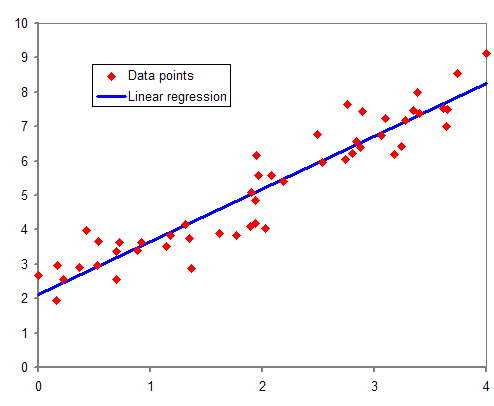
Image: Amatulic at English Wikipedia (same as Anachronist on Wikimedia), Public domain, via Wikimedia Commons
Mean squared error
Mean squared error (MSE) formula: MSE = (1/n) * Σ(y_i - ŷ_i)²
The mean squared error (MSE) is a measure of the average squared difference between estimated values (ŷ_i) and true values (y_i). It quantifies the accuracy of an estimator by calculating the squared errors, summing them up, and then averaging them over the number of observations (n).
MSE incorporates both the variance and bias of an estimator. Variance refers to the spread of the estimates across different data samples, while bias refers to the systematic error that occurs when the estimator consistently deviates from the true value. By squaring the errors, MSE ensures that all deviations are positive and emphasizes larger errors more significantly.
The MSE formula is crucial in fields like machine learning and statistics, where it serves as a risk function. It helps in evaluating and comparing different estimators by providing a single metric that reflects both variance and bias. A lower MSE indicates a better estimator that produces estimates closer to the true values.
Example
Suppose we have an estimator ŷ_i for the true values y_i of a dataset with 5 observations. The squared errors are as follows: (y_1 - ŷ_1)² = 4, (y_2 - ŷ_2)² = 9, (y_3 - ŷ_3)² = 1, (y_4 - ŷ_4)² = 16, (y_5 - ŷ_5)² = 0. The MSE is calculated as (1/5) * (4 + 9 + 1 + 16 + 0) = 6.
Understanding the MSE formula is essential for evaluating the performance of estimators in statistical models and machine learning algorithms. It provides a clear metric for assessing accuracy and helps in selecting the best estimator for a given problem.
Related concepts
Standard deviation
Standard deviation (σ) is the square root of variance
Expected value
Expected value formula: E[X] = Σ [x * P(x)]
Precision and recall
Precision = Relevant retrieved instances / All retrieved instances
Batch normalization
Batch normalization formula: Y = (X - μ) / σ * γ + β
BLEU
BLEU = exp(Σ(w_t * log(p_t)))
Mahalanobis distance
Mahalanobis distance formula: D^2 = (x - μ)'Σ^(-1)(x - μ)
One email a day: 5 concepts + the 5 stories that matter →
Swipe through 100 ML concepts daily
Open TickerNews