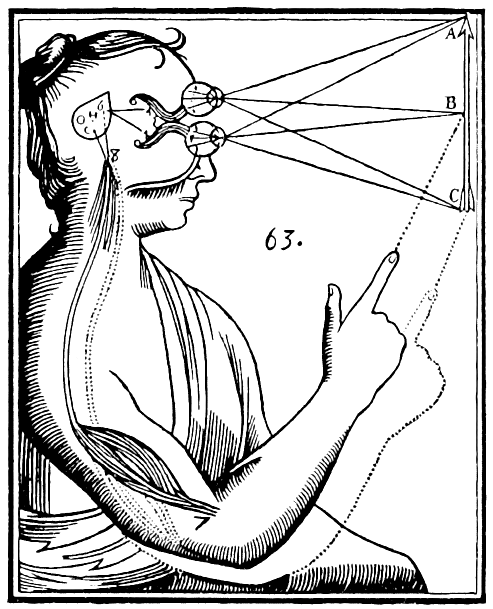
Mind-body problem: immaterial thoughts vs. physical brain
Mind–body problem
Mind-body problem: immaterial thoughts vs. physical brain
The mind-body problem explores the relationship between thought, consciousness, and the physical brain. Philosophers have debated whether mental states are distinct from physical states or if they are ultimately physical phenomena. This debate has evolved over centuries, with various theories such as dualism, monism, and non-reductive theories proposing different explanations.
The mind-body problem raises questions about causation between mental and physical events, the nature of consciousness, personal identity, and free will. These questions are central to understanding how immaterial thoughts and feelings interact with the material world. The problem remains significant in both philosophy and science, influencing fields such as cognitive science, neuroscience, and psychology.
Example
René Descartes' dualism posits that mind and body are fundamentally distinct substances, suggesting that mental states cannot be reduced to physical states.
Understanding the mind-body problem is crucial for advancing knowledge in philosophy, cognitive science, and neuroscience, as it addresses fundamental questions about consciousness and personal identity.
Related concepts
Hard problem of consciousness
Consciousness arises from physical processing
What Is It Like to Be a Bat?
Thomas Nagel's paper challenges the mind-body problem's solvability
Embodied cognition
Thinking is influenced by bodily state and capacities
Mind–body dualism
Mind–body dualism posits mental phenomena as non-physical
Binding problem
The binding problem is about integrating separate sensory inputs into a unified experience
Epiphenomenalism
Epiphenomenalism posits that consciousness is a by-product of physical brain states
One email a day: 5 concepts + the 5 stories that matter →
Swipe through 100 ML concepts daily
Open TickerNews