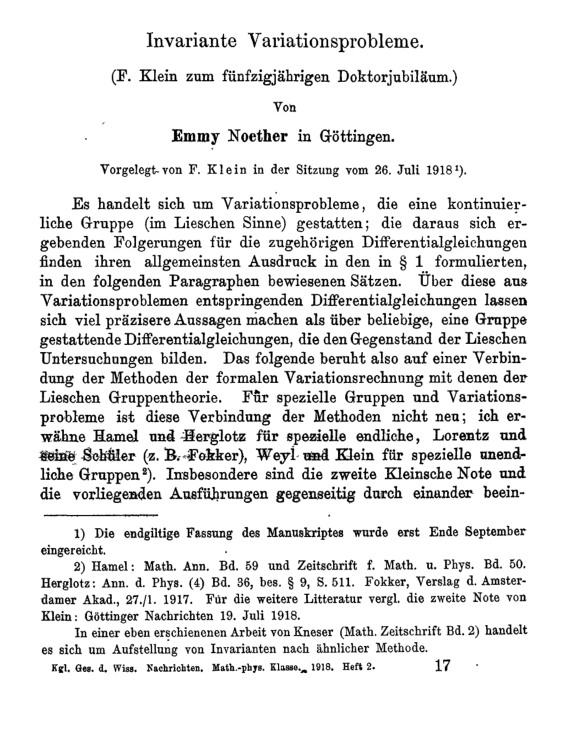
Noether's theorem links continuous symmetries to conservation laws
Noether's theorem
Noether's theorem links continuous symmetries to conservation laws
Noether's theorem establishes a fundamental connection between the symmetries of a physical system and its conservation laws. This profound insight has shaped our understanding of physics by revealing that symmetries lead to conserved quantities, which are essential for predicting the behavior of physical systems.
Example
In classical mechanics, the symmetry of a system under time translation corresponds to the conservation of energy. This means that if a system's laws do not change over time, its total energy remains constant.
Understanding this relationship is crucial for physicists as it provides a powerful tool for analyzing and predicting the behavior of physical systems across various fields of physics.
Related concepts
Symmetry (physics)
Symmetry leads to energy conservation
Emmy Noether
Emmy Noether proved Noether's theorem connecting symmetry and conservation laws
Goldstone boson
Goldstone theorem states every spontaneously broken continuous symmetry produces a massless boson
Spontaneous symmetry breaking
Spontaneous symmetry breaking occurs even when laws retain symmetry
Angular momentum operator
Angular momentum operator conservation
Bell's theorem
Bell's theorem disproves local hidden-variable theories
One email a day: 5 concepts + the 5 stories that matter →
Swipe through 100 ML concepts daily
Open TickerNews