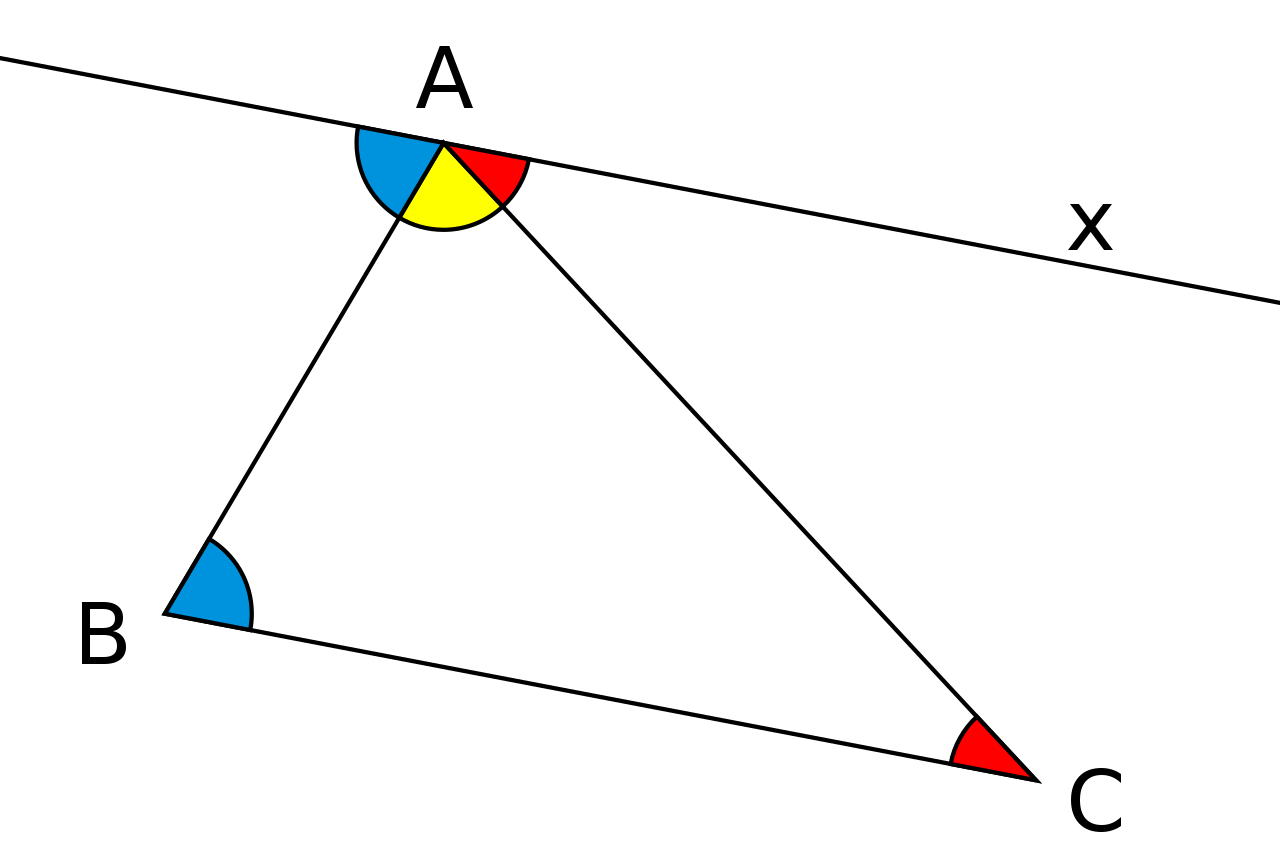
Sum of angles in a triangle equals 180 degrees
Sum of angles of a triangle
Sum of angles in a triangle equals 180 degrees
The sum of angles in a Euclidean triangle is always 180 degrees. This fundamental property of Euclidean geometry is essential for understanding the behavior of triangles in this space. It serves as a basis for many geometric principles and calculations.
Example
In a Euclidean triangle, if one angle measures 60 degrees and another measures 70 degrees, the third angle must measure 50 degrees to satisfy the sum of 180 degrees.
Knowing this property allows for accurate geometric constructions and problem-solving within Euclidean space.
Related concepts
Product type
Product types combine two types into a single structure
the union bound says: P(A∪B) ≤ P(A) + P(B)
The union bound states: P(A∪B) ≤ P(A) + P(B)
the dot product measures alignment: it equals |a||b|cos(θ)
Dot product measures alignment: it equals |a||b|cos(θ)
the trace equals the sum of eigenvalues: tr(A) = Σλ_i
The trace of a matrix equals the sum of its eigenvalues because it is the sum of the diagonal elements, which correspond to the eigenvalues in a diagonalizable matrix
Closed set
A closed set contains all its boundary points
Zero-sum game
Zero-sum game: one player's gain equals another's loss
One email a day: 5 concepts + the 5 stories that matter →
Swipe through 100 ML concepts daily
Open TickerNews