Random projection reduces dimensionality while approximately preserving pairwise distances
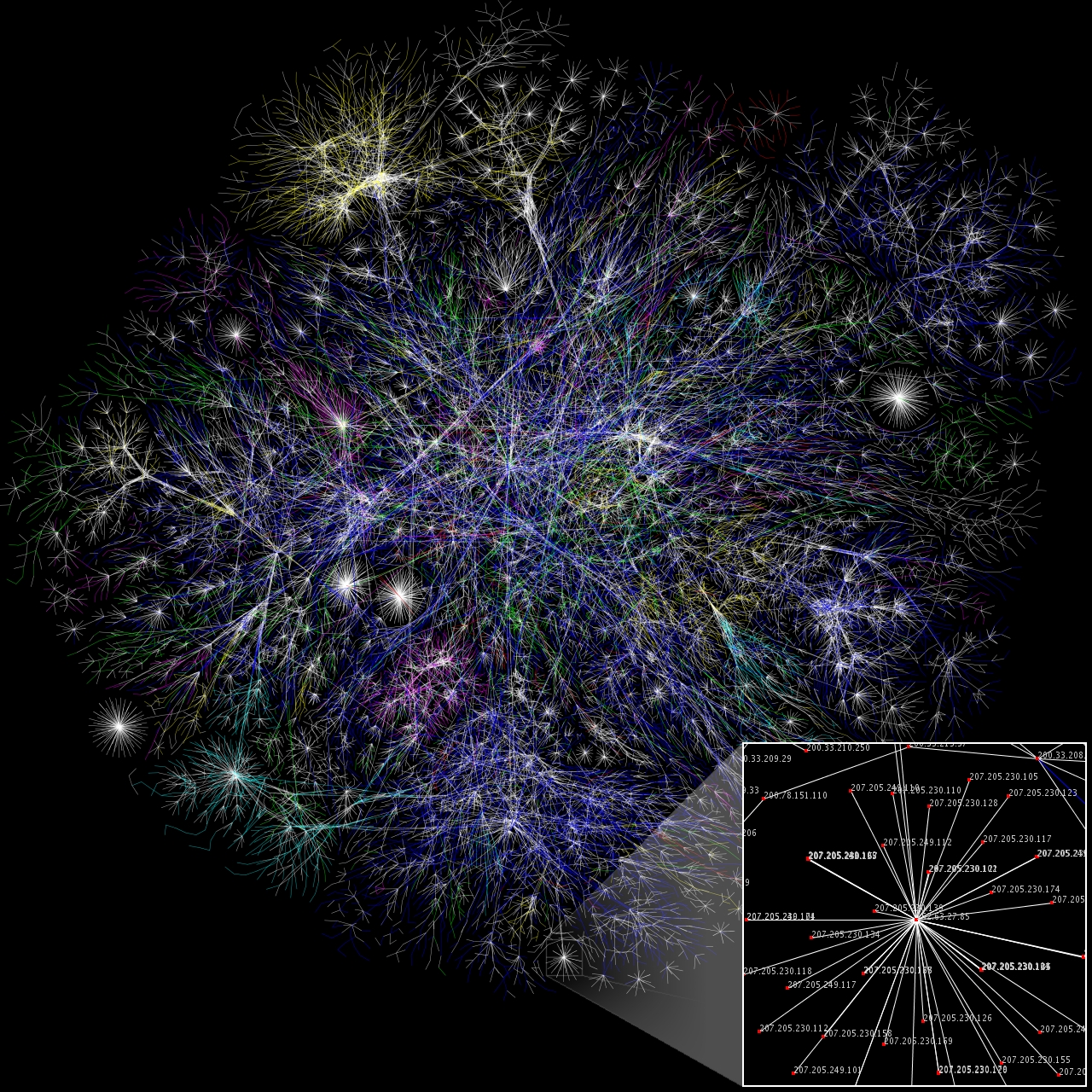
Image: The Opte Project, CC BY 2.5, via Wikimedia Commons
the Johnson-Lindenstrauss lemma says
Random projection reduces dimensionality while approximately preserving pairwise distances
Related concepts
random projection to O(log n/ε²) dimensions preserves pairwise distances within 1±ε
Random projection reduces dimensionality while preserving pairwise distances within ε² due to the Johnson-Lindenstrauss lemma
t-SNE preserves local structure
t-SNE preserves local structure by converting distances to probabilities and minimizing Kullback-Leibler divergence
List of unsolved problems in mathematics
Random points in high dimensions are nearly equidistant due to the uniform distribution of volume in high-dimensional space
non-convex loss landscapes are hard: many local minima and saddle points
Non-convex loss landscapes are hard due to many local minima and saddle points
the curse of dimensionality makes nearest neighbor search unreliable
High dimensionality dilutes data density, making nearest neighbors less distinct and search unreliable
cosine similarity works better than Euclidean distance in high dimensions
Cosine similarity measures orientation, not magnitude, making it more robust to irrelevant dimensions in high-dimensional spaces
One email a day: 5 concepts + the 5 stories that matter →
Swipe through 100 ML concepts daily
Open TickerNews