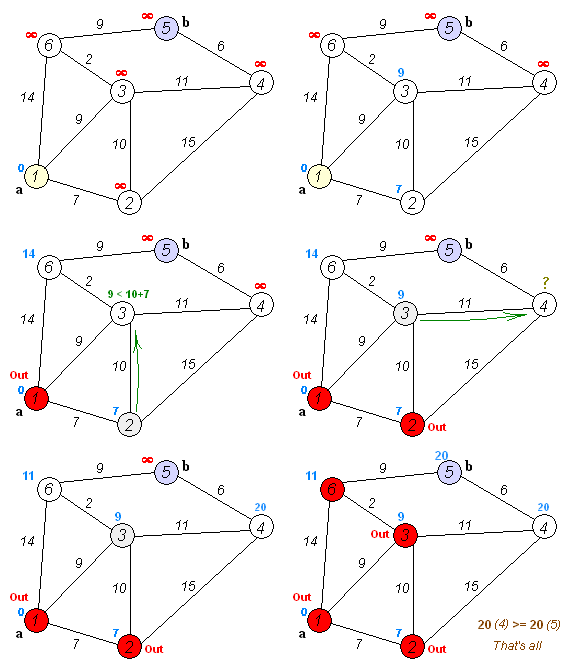
Dijkstra's algorithm: O((V+E) log V) using a Fibonacci heap
Time complexity of Dijkstra's algorithm: O((V+E) log V) with a priority queue
Dijkstra's algorithm: O((V+E) log V) using a Fibonacci heap
Related concepts
Time complexity of binary search: O(log n) — halves search space each step
Binary search reduces search space by half with each iteration, achieving O(log n) complexity
Time complexity of quicksort: O(n log n) average, O(n²) worst case
Quicksort's average-case time complexity: O(n log n), worst-case: O(n²)
Why attention is O(n²) in sequence length: every token attends to every other token
Attention mechanism's complexity arises from pairwise token interactions, leading to quadratic time complexity
What LSM trees optimize: write-heavy workloads by buffering writes in memory
LSM trees optimize write-heavy workloads through in-memory buffering
Why second-order methods (Newton's) converge faster but are expensive: O(n³) per step
Newton's method has quadratic convergence but requires cubic computational cost per iteration
What a message queue decouples: producer and consumer can operate at different speeds
Message queues decouple producers and consumers, allowing asynchronous processing
One email a day: 5 concepts + the 5 stories that matter →
Swipe through 100 ML concepts daily
Open TickerNews