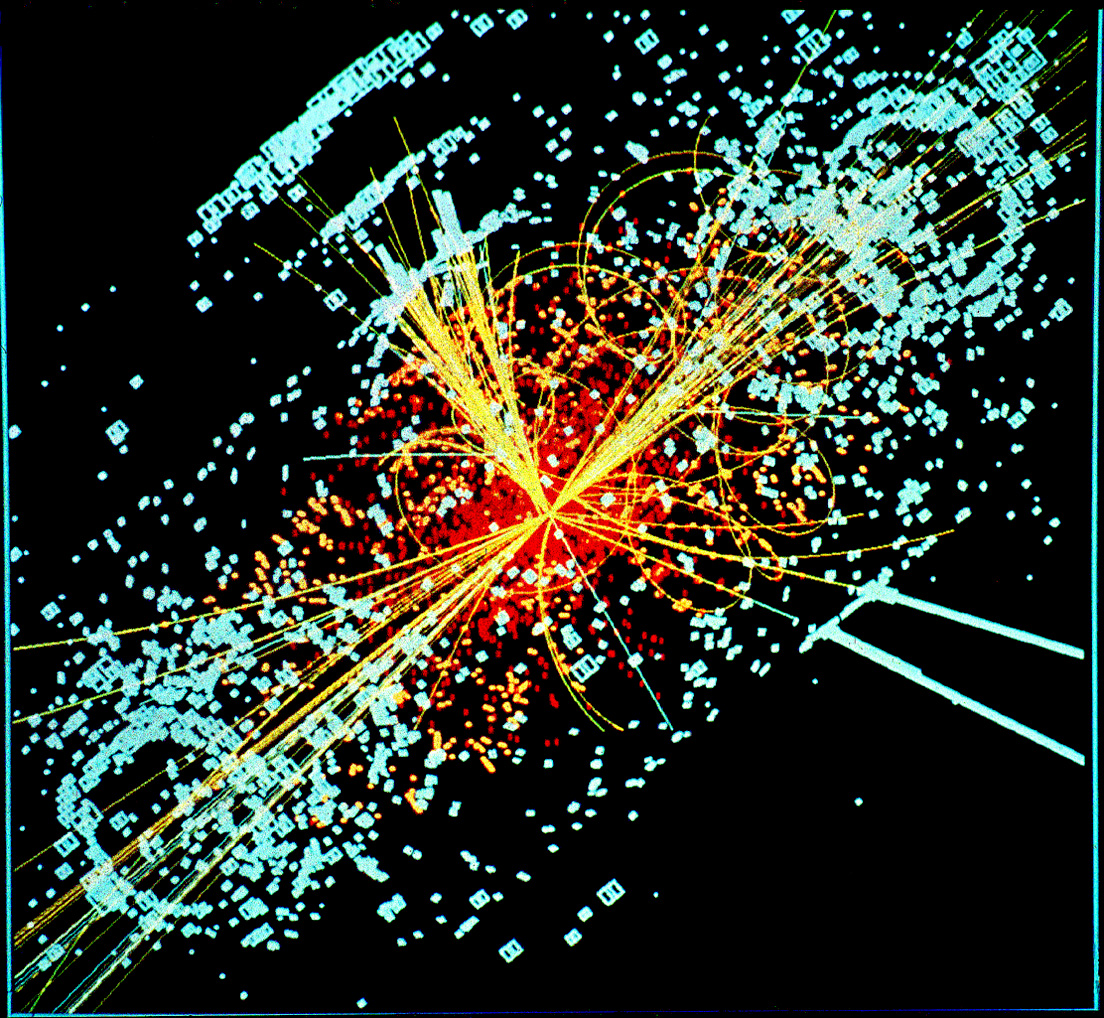
CP violation discovered in 1964 neutral kaon decays
CP violation
CP violation discovered in 1964 neutral kaon decays
CP violation refers to the phenomenon where the combination of charge conjugation (C) and parity (P) symmetries is not conserved in weak interactions. This discovery was significant as it revealed that the laws of physics are not identical when a particle is replaced by its antiparticle and its spatial coordinates are inverted.
The discovery of CP violation in 1964 in the decays of neutral kaons led to the Nobel Prize in Physics in 1980 for James Cronin and Val Fitch. This discovery has been observed in many other meson decays and more recently in baryons by the LHCb experiment in 2025. CP violation is crucial for understanding the matter-antimatter asymmetry problem, the strong CP problem, and the weak interactions in particle physics.
Under the CPT theorem, every CP violation is also a time-symmetry violation. This means that if CP symmetry is broken, it implies a violation of time-reversal symmetry as well, which has profound implications for our understanding of fundamental physics principles.
Understanding CP violation is essential for explaining why our universe is composed predominantly of matter rather than antimatter.
Related concepts
CPT symmetry
CPT symmetry is conserved in all physical phenomena
Strong CP problem
Strong CP problem: why does QCD not violate CP symmetry?
Asymptotic safety
Quarks interact more weakly at higher energies, earning the 2004 Nobel Prize
Goldstone boson
Goldstone theorem states every spontaneously broken continuous symmetry produces a massless boson
Dirac equation
Dirac equation implies existence of antimatter
Spontaneous symmetry breaking
Spontaneous symmetry breaking occurs even when laws retain symmetry
One email a day: 5 concepts + the 5 stories that matter →
Swipe through 100 ML concepts daily
Open TickerNews