Strong CP problem: why does QCD not violate CP symmetry?
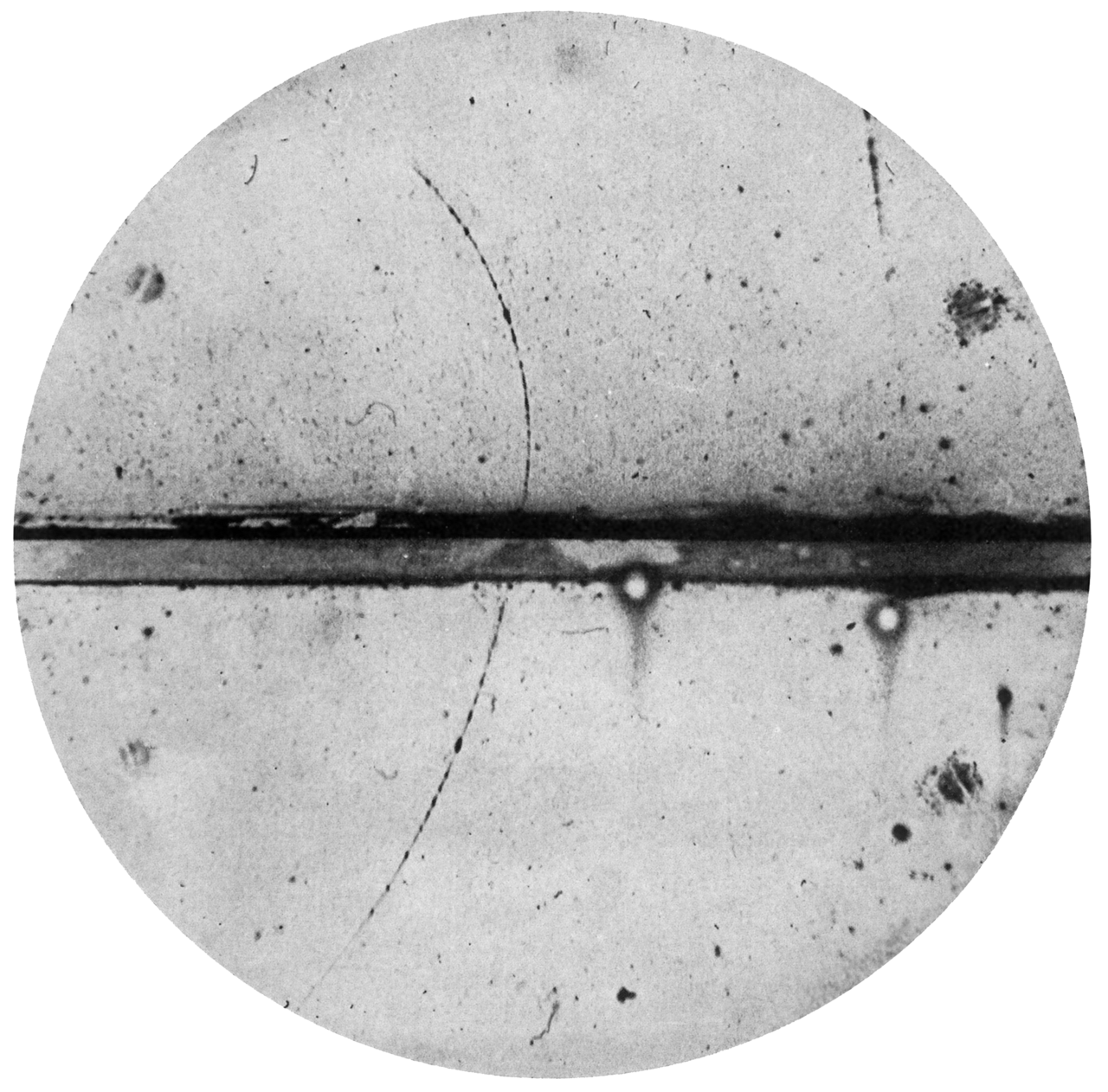
Image: Carl D. Anderson (1905–1991), Public domain, via Wikimedia Commons
Strong CP problem
Strong CP problem: why does QCD not violate CP symmetry?
Quantum chromodynamics (QCD) theoretically allows for CP-symmetry violation in strong interactions, yet experiments show no such violation.
The strong CP problem arises because QCD does not have a known reason to conserve CP-symmetry, leading to a fine-tuning issue in particle physics.
Several solutions, including the Peccei–Quinn theory with axions, have been proposed to address this unsolved puzzle.
Example
No experimental evidence of CP-symmetry violation in strong interactions despite QCD's theoretical allowance.
Understanding the strong CP problem is crucial for advancing theoretical physics and achieving a unified understanding of fundamental forces.
Related concepts
CP violation
CP violation discovered in 1964 neutral kaon decays
CPT symmetry
CPT symmetry is conserved in all physical phenomena
QCD (quantum chromodynamics) describes
QCD describes the strong force between quarks mediated by gluons
Asymptotic safety
Quarks interact more weakly at higher energies, earning the 2004 Nobel Prize
Goldstone boson
Goldstone theorem states every spontaneously broken continuous symmetry produces a massless boson
Spontaneous symmetry breaking
Spontaneous symmetry breaking occurs even when laws retain symmetry
One email a day: 5 concepts + the 5 stories that matter →
Swipe through 100 ML concepts daily
Open TickerNews