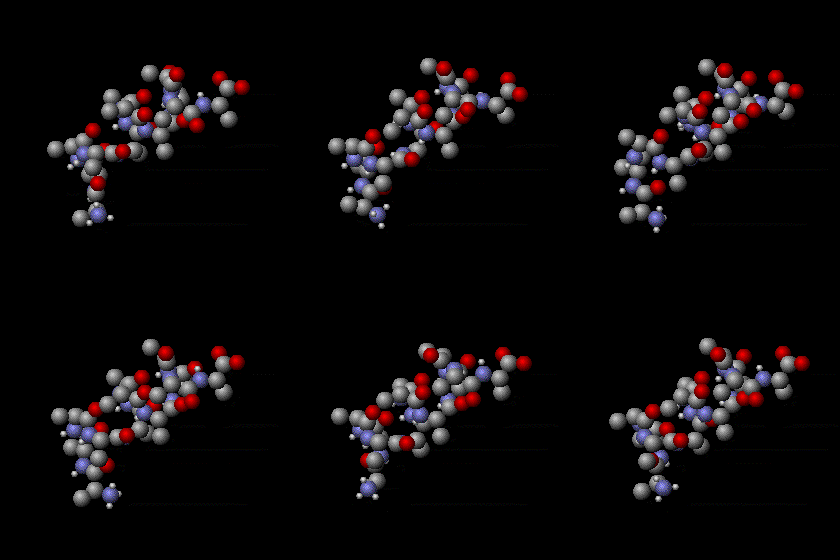
Equipartition theorem: Each degree of freedom contributes ½kT of energy at thermal equilibrium
Equipartition theorem
Equipartition theorem: Each degree of freedom contributes ½kT of energy at thermal equilibrium
The equipartition theorem is a fundamental principle in classical statistical mechanics that quantifies the relationship between temperature and energy distribution in a system. It asserts that energy is equally distributed among all degrees of freedom, ensuring that each contributes ½kT to the system's total energy at thermal equilibrium. This concept is crucial for understanding how energy is partitioned in different forms, such as kinetic and potential energy.
Example
In a monatomic ideal gas, each atom contributes ½kT of energy to its kinetic motion, where k is the Boltzmann constant and T is the temperature. This means that the total average kinetic energy per atom is 3/2kT, reflecting the equipartition theorem's prediction for translational motion.
Understanding the equipartition theorem is essential for predicting the average energy contributions of different degrees of freedom in a system, which is fundamental for calculating heat capacities and analyzing thermodynamic properties.
Related concepts
Second law of thermodynamics
Entropy of isolated systems never decreases
Maxwell–Boltzmann distribution
Probability of a state with energy E is proportional to e^(-E/kT)
Noether's theorem
Noether's theorem links continuous symmetries to conservation laws
Mass–energy equivalence
E=mc²
Asymptotic safety
Quarks interact more weakly at higher energies, earning the 2004 Nobel Prize
universality means in phase transitions
Universality in phase transitions implies identical critical exponents across diverse systems
One email a day: 5 concepts + the 5 stories that matter →
Swipe through 100 ML concepts daily
Open TickerNews