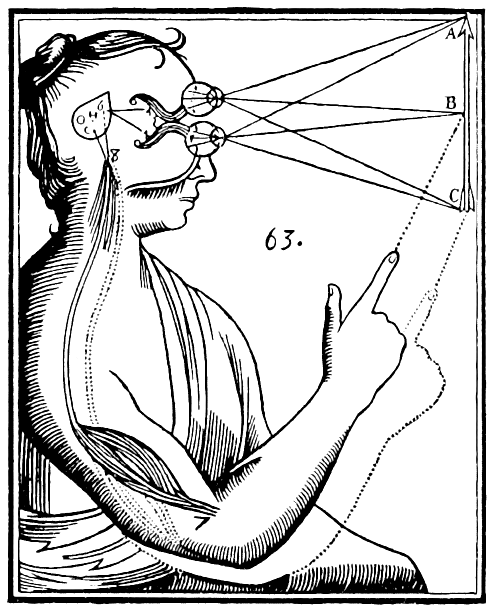
Dualism posits that mind and body are distinct, non-physical and physical substances, respectively
What substance dualism claims — mind and body are fundamentally different kinds of stuff
Dualism posits that mind and body are distinct, non-physical and physical substances, respectively
Related concepts
What functionalism claims about the mind — mental states are defined by their functional roles, not their material
Functionalism posits that mental states are characterized by their causal relations to inputs, outputs, and other mental states
What embodied cognition claims — thinking depends on having a body, not just a brain
Embodied cognition posits that cognition arises from interactions between an organism and its environment
What the extended mind thesis argues — cognition extends beyond the brain into tools and environment
The extended mind thesis posits that cognitive processes are distributed across the brain, body, and environment
How does the Twin Earth thought experiment challenge the internalism versus externalism debate in the philosophy of language and meaning?
Twin Earth suggests externalism, as meanings depend on environmental factors, not just internal cognitive states
What Putnam's Twin Earth thought experiment shows — meaning isn't just in the head
Putnam's Twin Earth demonstrates that meaning is partly in the external world, not solely in the mind
What nominalism claims — only particular things exist, universals are just names
Nominalism posits that only individual objects exist, universals are mere linguistic constructs
One email a day: 5 concepts + the 5 stories that matter →
Swipe through 100 ML concepts daily
Open TickerNews