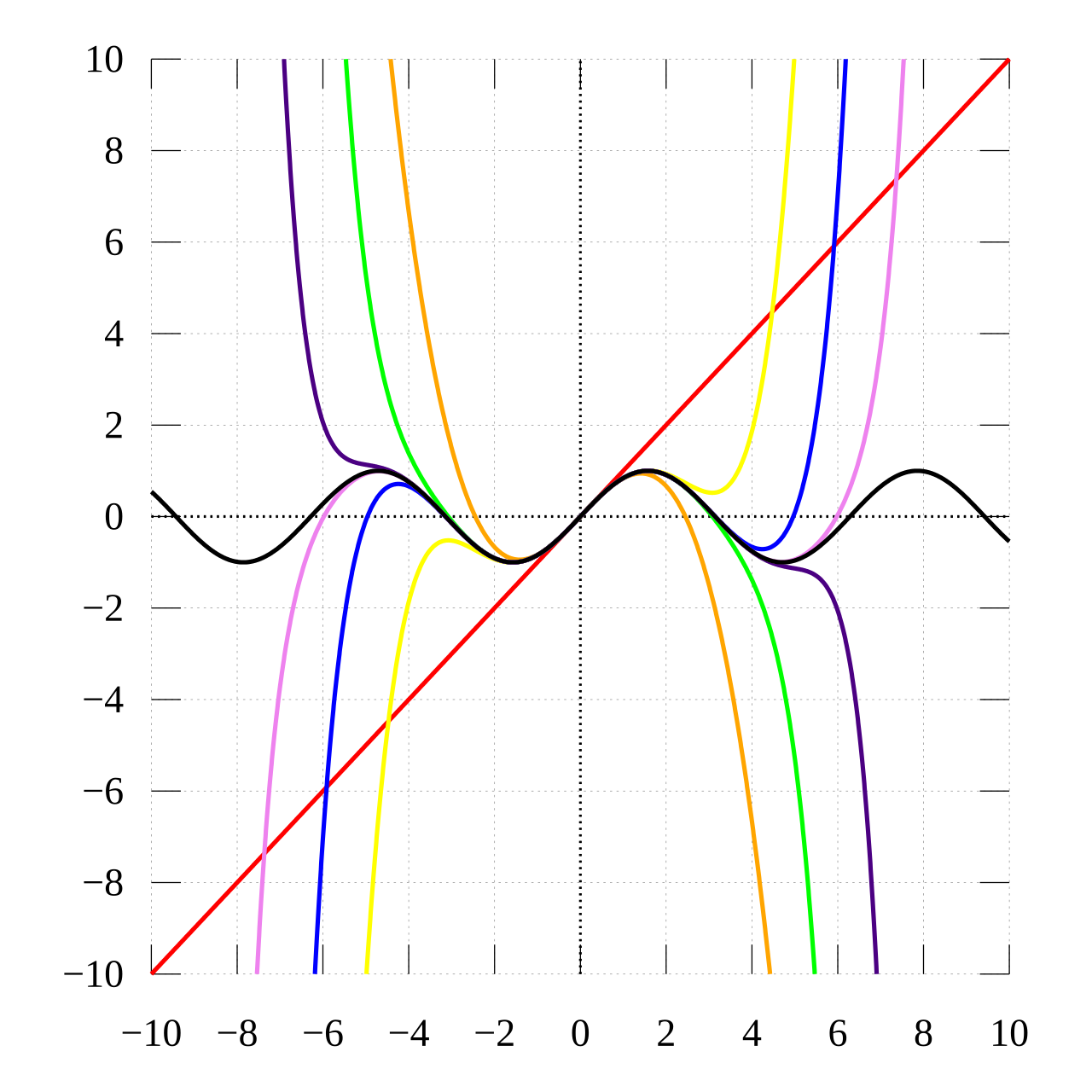
Taylor series formula: f(x) = f(a) + f'(a)(x-a) + f''(a)(x-a)²/2! +
Taylor series
Taylor series formula: f(x) = f(a) + f'(a)(x-a) + f''(a)(x-a)²/2! +
The Taylor series formula is an infinite sum representing a function's approximation around a point 'a'. It includes the function's value and derivatives at 'a', multiplied by powers of (x-a) and divided by factorial terms.
Example
For f(x) = e^x around a = 0, the Taylor series is f(x) = 1 + x + x^2/2! + x^3/3! + ...
Understanding the Taylor series formula is crucial for approximating functions and analyzing their behavior near a specific point.
Related concepts
Lagrangian L(x,λ) = f(x) - λg(x)
L(x,λ) = f(x) - λ(g(x) - c)
Euclidean distance
Euclidean distance formula: √((x2 - x1)² + (y2 - y1)²)
Mahalanobis distance
Mahalanobis distance formula: D^2 = (x - μ)'Σ^(-1)(x - μ)
Chain rule
Chain rule formula: h'(x) = z'(y(x)) * y'(x)
Mean squared error
Mean squared error (MSE) formula: MSE = (1/n) * Σ(y_i - ŷ_i)²
Pearson correlation coefficient
Pearson correlation coefficient formula: r = Σ[(xi - x̄)(yi - ȳ)] / [√(Σ(xi - x̄)²) * √(Σ(yi - ȳ)²)]
One email a day: 5 concepts + the 5 stories that matter →
Swipe through 100 ML concepts daily
Open TickerNews